The island’s seasonal return to an uninhabited state
The Summer BookThe island’s seasonal return to an uninhabited state is not a single departure but a gradual rearrangement of life: equipment is brought in, traces of habitation are cleared, and the landscape is left to weather and time. In August, this recurring work gives autumn a material shape. Grandmother welcomes the order of the change, yet her cleaning also makes the island feel increasingly distant from the people who have lived there. The retreat aims to restore the island as far as possible, but never quite achieves an absence of human presence.
August and the inward movement
The transition begins almost unnoticed. The bright Scandinavian nights fade, and an evening errand brings the sudden discovery of darkness. Summer has not ended, but its energy has ebbed: the season seems paused between growth and autumn. Against this uncertain interval, the family begins moving the necessities of summer toward the house. Sophia’s father takes in the tent and water pump, removes the buoy, and pulls the boat ashore on its cradle. The dory is turned upside down behind the woodyard. A few days later, the potatoes are dug and the water barrel is rolled against the house; buckets, garden tools, and ornamental pots follow. Objects that had belonged to life outdoors gather closer to shelter.
This inward movement is more than storage. The fire extinguisher, axe, pick, and snow shovel appear on the veranda, while the island’s seasonal landscape changes around them. Grandmother values the regularity of the process: each thing has its place, and the annual retreat follows a known order. The exhausted flower beds are covered with seaweed, and long rains level and rinse the ground. Red and yellow flowers still make bright patches above the covering; in the woods, a few enormous white roses bloom for a single day. The island is not simply packed away. Its human arrangement is being reduced while the weather continues its own work.
Clearing traces, preserving the place
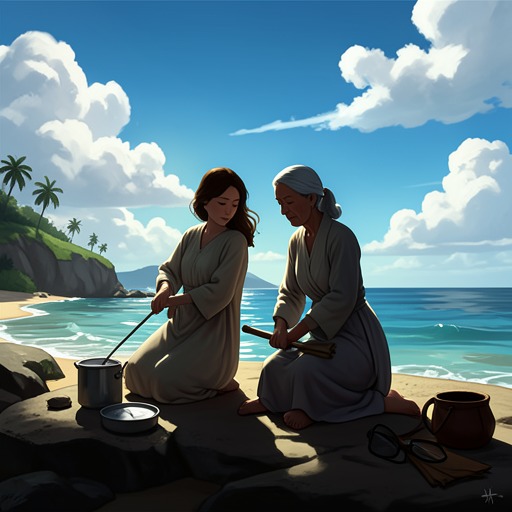
Grandmother goes outside briefly each day before dark, despite aching legs that limit how far she can walk. She gathers what human beings have left behind: nails, scraps of paper and cloth, plastic, oil-stained lumber, and bottle tops. At the shore she builds fires for burnable rubbish. The task makes the island cleaner, but also, in her perception, more foreign and remote. She senses it shaking off its inhabitants. Her purpose is to remove evidence of occupation, not to make the island careless or unprepared.
Sophia’s father performs a different kind of closing work, protecting what will remain. He paints the ringbolts with red lead, treats the veranda with seal fat, oils tools and hinges, sweeps the chimney, and puts away the nets. He stacks wood by the stove both for the family’s return in spring and for anyone shipwrecked on the island. Because the woodshed stands near the high-water mark, he ties it down with ropes. His preparations recognize that the island may be empty of its usual occupants without being beyond danger or need.
Grandmother’s own instructions extend that care toward hypothetical arrivals. She wants coarse salt brought up from the cellar and labelled so that nobody mistakes it for sugar; she worries about damp swelling the trapdoor, wet leggings, trampled flower beds, and damage to roots. When she considers the stovepipe, she warns that its damper must not be closed in case it rusts shut or a bird nests in the chimney before spring. Sophia’s father points out that the family will be back, but Grandmother resists treating that return as a guarantee against every intervening possibility. The island is being left, not abandoned to indifference.
A house prepared for absence
The preparations make the house serve as a shelter for people who may never arrive. Grandmother takes down the curtains early and covers the south and east windows with disposable paper bedsheets. On them she leaves practical instructions: not to remove the covers, because autumn birds might fly through the house, and to use what is needed while carrying in more wood. She lays out cigarettes and candles in case the lamp fails. She hides the barometer, sleeping bags, and seashell box under the bed, later brings the barometer out again, and leaves a figurine visible because she thinks a little culture will do no harm. Sophia’s father leaves the rugs down so the room will not seem unfriendly over winter.
These acts blur the line between departure and hospitality. Grandmother is trying to remove the family’s temporary presence, yet she arranges the house for unknown occupants and leaves them supplies, warnings, and an invitation to make use of what they find. Covering two windows changes the room itself: it becomes secretive and conspiratorial, but also very lonely. The shelter’s usefulness and its loneliness arise from the same preparation. It is ready for other people precisely because its familiar residents are going away.
The island is never wholly empty
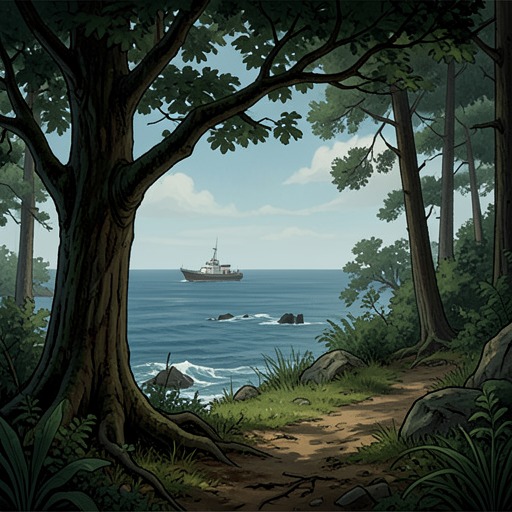
The seasonal retreat belongs to a wider pattern in which the island’s apparent remoteness is repeatedly unsettled. A businessman’s house on Blustergull Rock breaks the familiar horizon and ends the family’s position as the people living farthest out. A private-property sign at the shore prompts Grandmother and Sophia to land in protest, while Grandmother predicts that the new neighbour will build a dock despite wanting to be left alone. Later, storms make them think about Malander and how his boat might be saved. The new house remains a landmark even when its owner does not return their visit. The island’s boundaries are lived and contested, not sealed off from the mainland or from newcomers.
Other summer episodes make the same exposure tangible. A bulldozer tears through woods to build a road to the sea, lifting ancient boulders and uprooting pines; its broad, raw track stands against the idea that the landscape can simply be restored by putting summer things away. During Midsummer, boats converge on floating crates in the Gulf of Finland, and the salvage fleet disperses toward separate homes by dawn. In the heatwave, Sophia’s father carries a pump and hoses to a bog and tries to tow an enormous plastic reservoir of water back across the sea. These episodes show the island connected to roads, boats, work, weather, and resource needs. August’s cleaning cannot erase those connections or guarantee that the landscape will remain untouched.
The retreat therefore has a deliberate limit. Grandmother gathers rubbish and imagines the island growing uninhabited, while the household leaves behind protected supplies, maintenance, and instructions for whoever might need them. The family expects to return, but the work of preparing for absence acknowledges that the island persists beyond their seasonal life. Its temporary emptiness is neither pristine wilderness nor permanent abandonment: it is a carefully tended interval between departures and return.